Learning Swift

After months of internal deliberation, I've come to the conclusion that it's finally time for me to learn Swift. Since I started working at Kinsta a year and a half ago, I've felt inspired to learn how to code – probably because I get to see the work of our awesome developers firsthand.

Initially, I tried learning JavaScript, but quickly gave up on it because I realized I have no intention to build webapps, and I think there are better languages for backend development. Next, I moved on to Python, which I was able to pick up pretty quickly. I actually really like Python. The language makes sense to me, and I was able to prototype ideas quickly. ICON, the blockchain project I do a lot of work for, uses Python primarily, so I was able to develop a few ICON blockchain-related tools as well.

I've also written a variety of personal Python scripts to boost productivity by automating repetitive tasks.

I know enough Python now to be happy. I don't see myself ever becoming a Python developer because I'm not super interested in automation, infrastructure deployment, and API development – a few things which Python excels at.

I am quite interested in developing apps in the Apple ecosystem though. Over the years, I've continuously procrastinated learning Swift because I kept telling myself that learning a platform-specific language is limiting. Recently, I came to the realization that learning a niche language like Swift might actually be good for me. I have a tendency to try too many things at once. For example when I was learning Python, I got sidetracked with trying to figure out Django, Ansible, and Flask all at once – it ended up being a huge waste of time because I only really needed Python for blockchain and automation work. Thus, I think limiting myself to creating an iOS app with Swift will be a refreshing experience.

For now, I'm going through the Swift documentation. Next week, I'm going to start a Udemy course that was on sale for $11.99 (wow). I'm hoping to set aside one hour a day early in the morning for learning Swift, but I'm not going to put too much pressure on myself because life with a full time job and a baby in the middle of a global pandemic is difficult.

I'll provide a progress update every week or two. Stay tuned!
Zoom Acquires Keybase →

Keybase:

Initially, our single top priority is helping to make Zoom even more secure. There are no specific plans for the Keybase app yet. Ultimately Keybase's future is in Zoom's hands, and we'll see where that takes us. Of course, if anything changes about Keybase’s availability, our users will get plenty of notice.

This is a very interesting acquisition. Optics-wise, I think it's a win for Zoom. Technical and privacy-minded people who respect Keybase may reconsider Zoom after this acquisition. On the flipside, mainstream consumers will see this headline as "Zoom partners with security company to enhance privacy features" – these are the people who likely didn't care much about Zoom's security flaws in the first place, so reading a headline like this will only make Zoom "even better" in their minds.

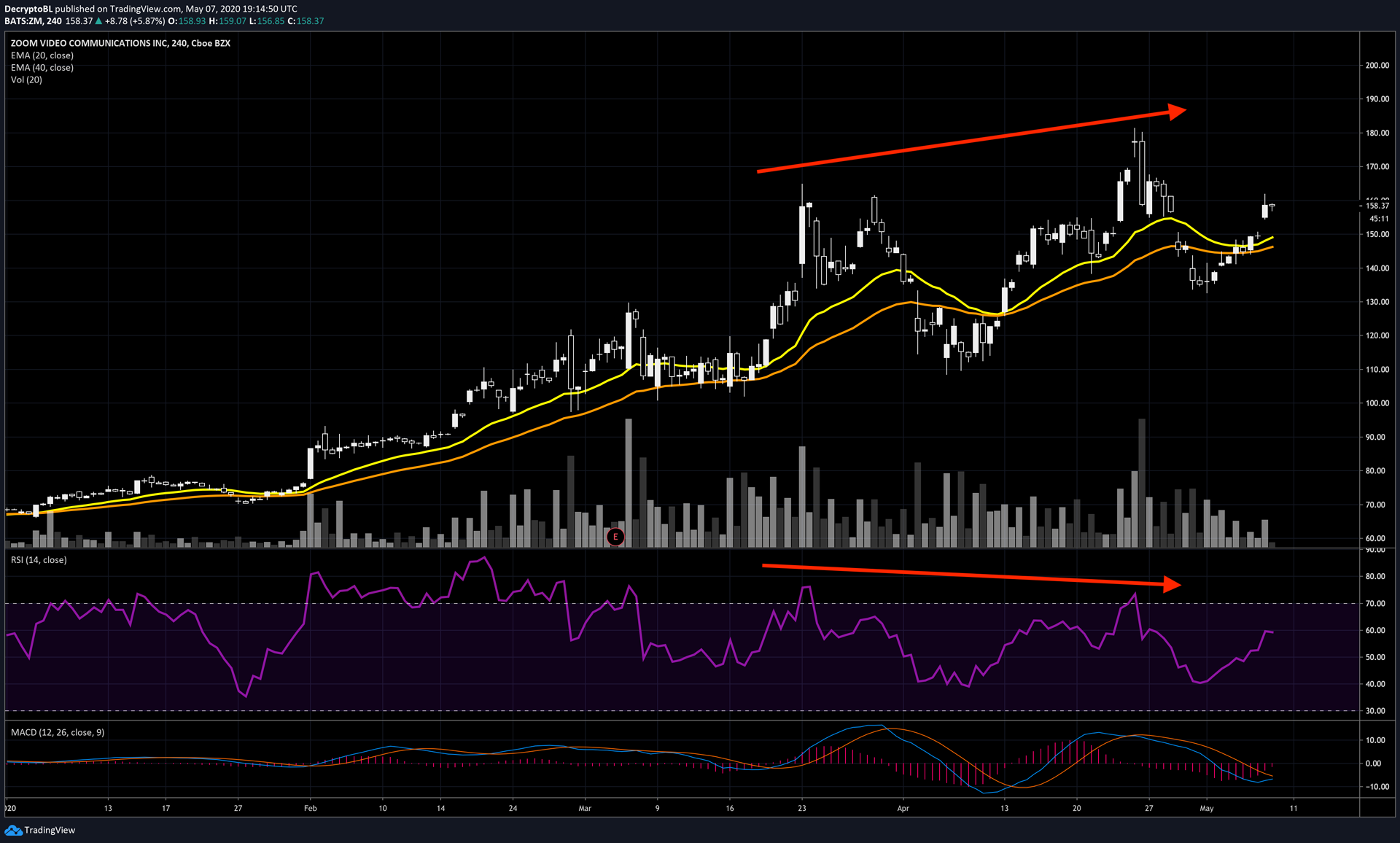
This acquisition announcement also comes at somewhat of a key time in terms of Zoom's stock performance. Over the past week and a half, buy pressure on $ZM has been easing up – a clear bearish divergence can be spotted on the 4H chart.

$ZM has undoubtedly been a hot stock since the start of the COVID-19 pandemic – approximately 160% in the green. Now that Zoom has "normalized" around the world, there needs to be another hype cycle to keep the rally going. The acquisition of a company that focuses on Zoom's biggest flaw (security) seems like a "cheap" way to keep the stock rallying.

$ZM is up 6.5% today. Zooming out, I think a short opportunity down to the $105-110 range isn't too far away.

« Permalink »

How to Host an Online Zoom Concert with MainStage

Ever since the start of the COVID-19 pandemic, I've seen quite a few of my musician friends host online concerts with Zoom. While I'm probably not going to host concerts myself (I haven't practiced piano in a year), this got me thinking about how to help others to improve the production quality of their online concerts to create a better experience for viewers. In this post, you'll learn how to host a great-sounding Zoom concert with Apple MainStage.

Continue Reading →

How Many Strings on Your Next Electric Bass?

Bass guitarists today have many options for the number of strings to have when purchasing a new bass, from 4- to 5-string options to 6-strings and beyond, and with a healthy mix of options across bass brands. We’ll go into these types below, and discuss the differences between 4, 5, and 6-string basses, along with the reasons for choosing each type with associated long-term considerations.

Continue Reading →

Lost in Las Vegas

In the summer of 2015, I visited Las Vegas for the first time. I had been hired to work on a large Dragone production in China, and the composer for the show, Michael Brennan, was based in Las Vegas. Michael decided to fly me over to Las Vegas to start doing some prep work for the show.

Continue Reading →

How to Track Mailchimp Form Submission URLs

Recently, I started researching how to integrate an email newsletter signup form on my site. A few of my colleagues at work use HubSpot heavily, so I decided to check that out first. After creating an account and going through a few tutorials, I realized it was too complicated for my use case. I ended up reverting to MailChimp, which I've used on sites in the past.

Continue Reading →

How to Record Multitrack Audio from MainStage to Logic Pro X

While MainStage has built-in recording capabilities, tracking to a proper DAW like Logic Pro X provides much more flexibility. If you want to run MainStage and record to Logic Pro X on the same computer with no quality loss, you'll need a digital audio router of some sort. It's technically possible to use either S/PDIF or ADAT for this kind of recording setup, but it's much simpler to route audio in software – no cables and higher channel counts. In this post, you'll learn how to record multitrack audio from MainStage to Logic Pro X with Loopback.

Continue Reading →